
When I talk with engineers or purchasing managers around the world, one question always comes up — “Which type of monochrome LCD should I choose: TN, STN, or FSTN?”
It sounds like a simple question, but the answer depends on how your device is used, the required visibility, and the environment in which it operates.
At Longtech Optics, we have been manufacturing LCD modules since 2005, and through these years I’ve seen how each technology has its strengths and limits.
In this guide, I’ll explain the differences between TN, STN, and FSTN LCDs, share some real-world insights, and help you make the best choice for your industrial application.
Why Monochrome LCDs Still Matter in Industrial Devices
In the age of full-color TFT and OLED screens, you may wonder: why are so many industrial devices still using monochrome LCDs?
The reason is reliability. Industrial and medical environments demand displays that can operate for 5 to 10 years without failure, even under extreme temperatures or vibration.
Monochrome LCDs — especially TN, STN, and FSTN types — are low-power, cost-effective, and highly stable. They don’t suffer from burn-in or sudden color degradation.
These displays continue to dominate fields like:
- Smart meters and energy systems
- Industrial control panels
- Medical diagnostic equipment
- Laboratory instruments
- Automotive dashboards
Unlike consumer TFT panels, monochrome LCDs can be customized easily. We can adjust backlight color, viewing direction, polarizer type, and even the driver IC to match your hardware.
That flexibility keeps them alive in a world moving fast toward color.
Understanding the Core Technology: TN, STN, and FSTN
Before we compare, it’s important to clarify one thing:
The term “TN” can refer to two very different display technologies.
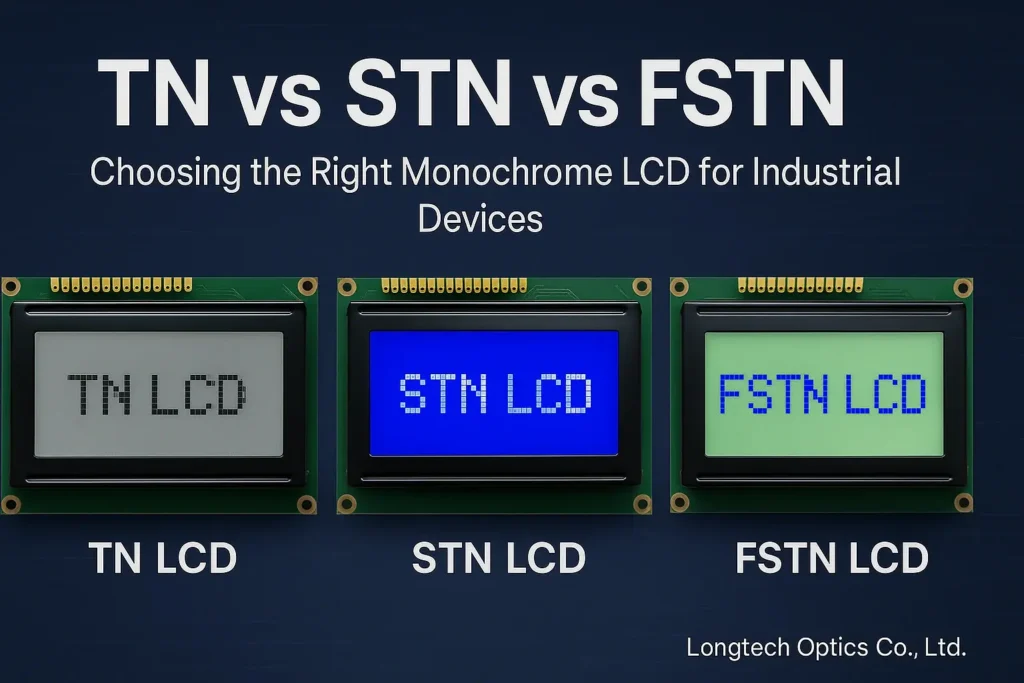
- Monochrome TN LCD — a passive matrix technology, common in character or segment displays.
- TFT TN LCD — a color active matrix display, often used in laptops or automotive screens.
In this article, we focus only on monochrome TN, STN, and FSTN displays used in industrial and embedded systems.
TN LCD (Twisted Nematic): Fast, Simple, and Cost-Effective
If you’ve ever seen a calculator, a thermostat, or a pressure gauge — chances are it used a TN LCD.
This is the oldest and most mature liquid crystal technology.
TN stands for Twisted Nematic. Inside each pixel, the liquid crystal molecules twist about 90°, controlling light when a voltage is applied.
Because the structure is simple, response time is fast, and power consumption is minimal.
Advantages:
- Extremely low cost
- Low power consumption
- Fast response time (great for dynamic numbers)
- Easy to drive with simple controllers
Disadvantages:
- Narrow viewing angle (especially vertically)
- Lower contrast compared to STN and FSTN
- Limited background and segment colors
Most TN LCDs are single color — black on gray, or blue background with white characters.
At Longtech, we often use TN modules in segment LCD displays, such as FP1102P the series.
They are perfect for stable devices where cost and speed matter more than aesthetics.
STN LCD (Super Twisted Nematic): Balanced Contrast and Viewing Angle
The STN (Super Twisted Nematic) display was a big step forward.
It increases the twist angle of the liquid crystal layer from about 90° to 200°~270°, which significantly improves contrast and viewing angle.
This technology allows dot matrix displays with complex graphics — for example, a 128×64 graphic module displaying icons, menus, or waveforms.
STN screens are also more readable in bright environments and can be paired with different backlight colors.
Advantages:
- Better viewing angle than TN
- Higher contrast ratio
- Supports more complex dot-matrix graphics
- Suitable for both positive and negative modes
Disadvantages:
- Slightly slower response time
- Color shift (yellow-green or blue) depending on polarizer and liquid crystal mix
For many industrial devices, STN LCDs strike the best balance between cost and readability.
They are widely used in test instruments, telecom devices, and handheld terminals.
At Longtech, we produce hundreds of STN models, such as Character LCD and Graphic LCD, with customizable backlight and interface (SPI, I2C, parallel).
FSTN LCD (Film Compensated STN): Enhanced Visual Performance
Then comes the FSTN, or Film Compensated Super Twisted Nematic LCD.
It adds a compensation film on top of the STN layer to eliminate the unwanted color tint and achieve a pure black-and-white appearance.
The result?
Sharper contrast, better readability, and wider viewing angles — especially important for devices used in medical or automotive environments where users read from different positions.
Advantages:
- Highest contrast among TN family
- True black characters on white or silver background
- Widest viewing angle
- Professional and modern appearance
Disadvantages:
- Slightly higher cost
- Marginally slower response time than TN
When customers come to us asking for a display that “looks almost like e-paper but still runs on simple logic,” we usually recommend FSTN. (Character LCD and Graphic LCD)
It’s ideal for medical instruments, diagnostic testers, and premium control systems that require both clarity and stability.
Technical Comparison Table
| Feature | TN LCD | STN LCD | FSTN LCD |
|---|---|---|---|
| Display Type | Monochrome (Passive Matrix) | Monochrome (Passive Matrix) | Monochrome (Passive Matrix) |
| Contrast Ratio | Low | Medium | High |
| Viewing Angle | Narrow | Wider | Widest |
| Response Time | Fast | Medium | Slightly slower |
| Power Consumption | Lowest | Moderate | Moderate |
| Cost | ★ | ★★ | ★★★ |
| Color Tone | Black on Gray / Blue | Yellow-Green / Blue | Black on White |
| Temperature Range | -20°C ~ +70°C | -20°C ~ +70°C | -30°C ~ +80°C |
| Typical Applications | Meters, tools, control panels | Graphic displays, POS terminals | Medical, automotive, industrial automation |
How to Choose the Right LCD for Your Application
Now that we know the differences, let’s talk about how to choose wisely.
Every industrial application has unique priorities: cost, readability, power, or temperature range.
1. For Basic Numeric or Text Displays → TN LCD
If your product only needs to show digits, letters, or symbols, TN LCD is the simplest and most cost-efficient option.
Think of thermostats, power meters, kitchen appliances, or factory counters.
They are reliable, easy to drive, and available in thousands of standard sizes without tooling cost.
2. For Simple Graphics or Menus → STN LCD
When you need to display icons, graphs, or multi-line information, STN is the better choice.
It supports higher resolution and maintains good visibility in daylight.
STN modules also offer more flexible viewing directions — top, bottom, left, or right.
For example, many of our clients in telecom and measurement industries choose STN 128×64 modules because they can easily show signal strength bars, waveforms, or multi-level menus.
3. For High-End or Medical Devices → FSTN LCD
If you care about professional look and legibility, FSTN wins.
Its pure black-on-white display offers a crisp appearance similar to a printed label, making it ideal for medical analyzers, blood pressure monitors, or smart home panels.
Even under bright sunlight, FSTN remains clear and consistent.
4. Consider the Assembly Type – COB, COG, or TAB
Choosing the display technology is just one part of the story.
The assembly method also affects thickness, cost, and reliability.
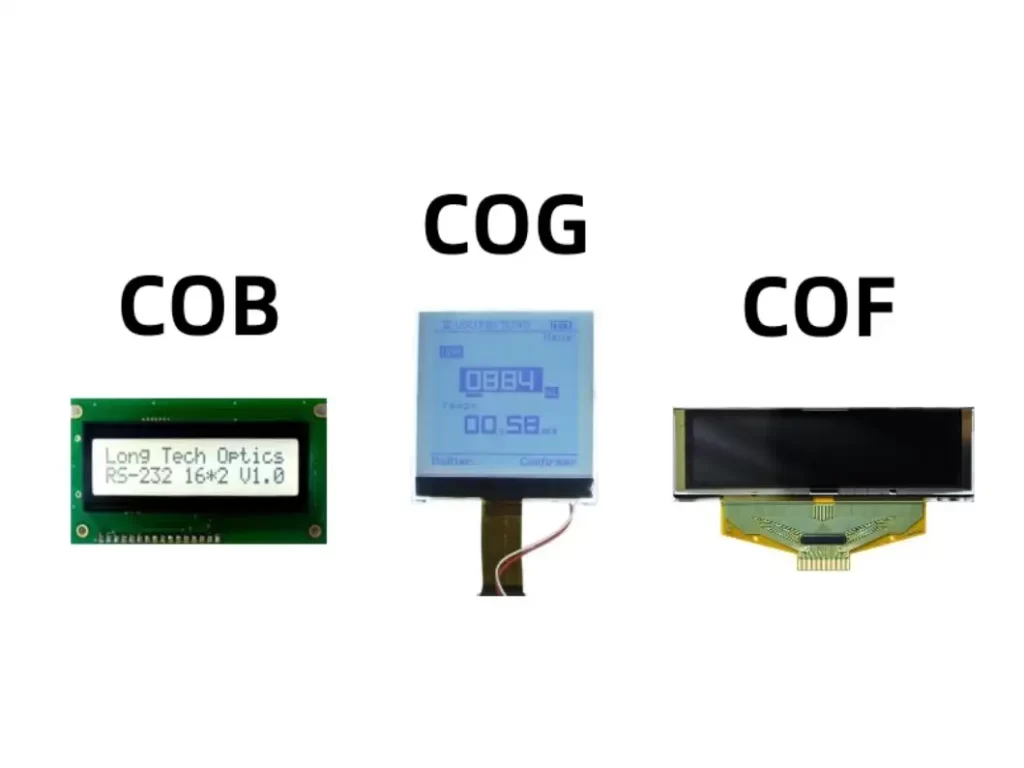
- COB (Chip on Board) – Driver IC mounted on the PCB. Reliable and easy to repair.
- COG (Chip on Glass) – IC directly bonded to the glass. Thinner, lighter, and perfect for compact designs.
- TAB (Tape Automated Bonding) – Used for special interfaces requiring flexibility.
In most new designs, we recommend COG LCD modules for their compact size and high stability.
Our COG series combines TN/STN/FSTN panels with modern interfaces like SPI and I²C.
More details: COB vs COG vs COF LCD Modules
Monochrome LCD vs. TFT: When to Upgrade
Many customers ask me, “Should I move from monochrome to color TFT?”
It depends.
If your product is cost-sensitive, battery-powered, or must operate for 10 years in the field, monochrome LCD is still the king.
If you need vivid colors or video playback, then TFT is worth considering — but expect higher power and shorter lifespan.
That’s why at Longtech we supply both: monochrome modules for stability, and TFT modules for advanced interfaces.
We help clients transition gradually as technology and budgets evolve.
More details: What is the Difference Between Graphic LCD and TFT LCD?

Backlight Options: LED and RGB Customization
Backlight determines not only the visibility but also the style of your product.
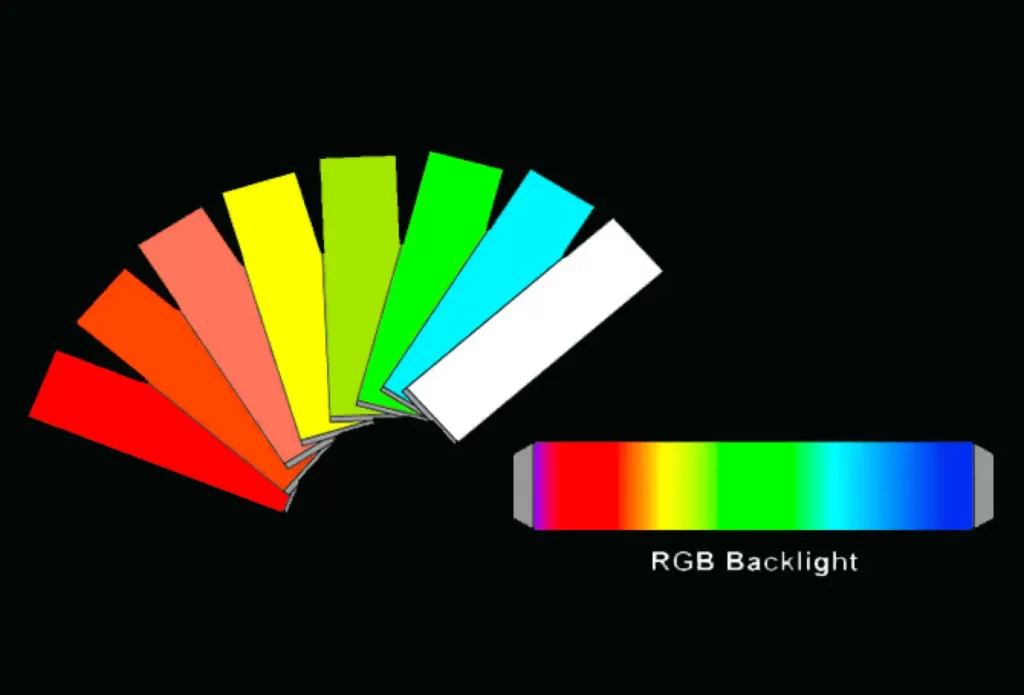
We provide various options — white, amber, green, blue, or even RGB adjustable backlights for multi-status indications.
For example, one customer designed a diagnostic tester where the backlight changes:
- Green → normal operation
- Yellow → warning
- Red → fault detected
That simple backlight function saved them from adding extra LEDs or alarms.
It’s a great example of how display design can improve user experience.
More details: What is LED Backlight?
Environmental Reliability: Why Lifespan Matters
Industrial environments can be tough — high humidity, vibration, or outdoor temperatures.
That’s why we design our LCD modules for long-term reliability.
Each Longtech display undergoes:
- High-low temperature tests (-30°C to +80°C)
- UV aging tests
- Thermal shock cycles
- Long-hour backlight burn-in
Over 90% of our standard LCD products come with 3~10 years guaranteed supply.
We never discontinue a model without a long transition plan — a promise our long-term partners deeply appreciate.
Why Choose Longtech Optics
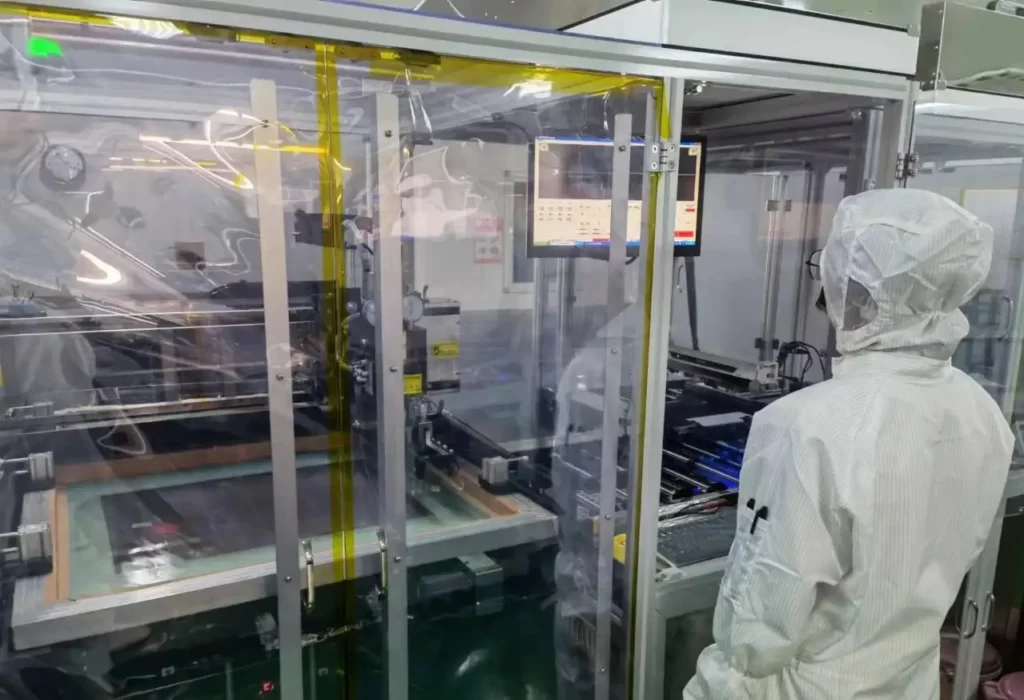
When clients visit our factory, the first thing they notice is how much effort we put into every detail.
We are not just assembling displays; we are engineering reliability.
Here’s what sets us apart:
- 20+ Years of Manufacturing Experience
We’ve been specializing in small and medium-sized LCD modules since 2005. - Thousands of Standard Models
From 8×2 character modules to 320×240 graphic LCDs, most require no mold fee. - Long-Term Supply Guarantee
90% of our products can be supplied for 3–10 years, perfect for industrial and medical customers. - Comprehensive Product Line
TN, STN, FSTN, VA, TFT, OLED, and full system integrated solutions — all under one roof. - Flexible Customization
We support COG, COB, and custom display shapes, including custom icons, segment layouts, and logo integration. - Excellent Cost-Performance Ratio
Our supply chain and in-house engineering allow us to provide premium quality at a competitive price. - Global Logistics Support
Warehouses and shipping partners in China, the USA, and Europe ensure fast delivery and after-sales service.
When you work with us, you get more than a display supplier — you get a partner who understands your product.
Conclusion
Whether you choose TN, STN, or FSTN, each type of monochrome LCD has its place.
If you value simplicity and speed — go with TN.
If you need balanced visibility — choose STN.
If you want premium contrast and readability — FSTN is your answer.
At Longtech, we help engineers and OEMs worldwide find the perfect balance between performance, cost, and longevity.
Our mission is simple — to make industrial displays that last for years, perform flawlessly, and keep your business running without interruption.
If you’re designing a new device or upgrading your existing model, we’d love to help you choose the most suitable LCD.
You can reach me directly through our website or contact our sales engineers for free technical consultation and samples.
👉 Contact Longtech Optics Co., Ltd.
Let’s build your next generation of industrial displays — together.
